
Arbi Ka Paratha
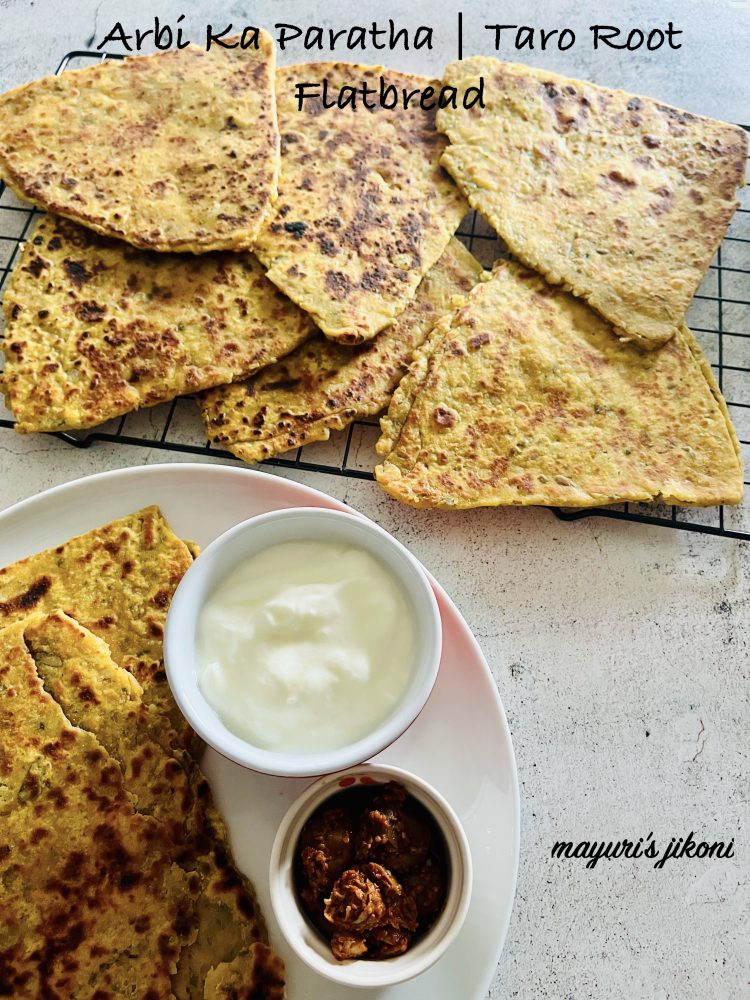
Recipe: Arbi Ka Paratha
What Is Arbi?
Memories
Present Time
Sharing Arbi Ka Paratha With The Group Bread Bakers

Check Out How Members Of Bread Bakers Used Roots
- Beetroot Bread from Sara’s Tasty Buds
- Caramelized Onion Cheddar Breadfrom Hezzi-D’s Cooks and Books
- Caramelized Onion Gouda Casatiello from Hostess at Heart
- Carrot Spiced and Teff Bread from kidsandchic
- Colocasia Root (Taro Root) Flatbread from Mayuri’s Jikoni
- Garlic and Herb Wreath Bread from Herbivore Cucina
- Garlic Cheese Bombs from Sizzling Tastebuds
- Ginger Sweet Rolls from Passion Kneaded
- Korean Onion Breadfrom Gayathri’s Cook Spot
- Pull Apart Onion Bread from A Day in the Life on the Farm
- Rustic Parsnip Bread from Food Lust People Love
- Sourdough Onion Pockets from Karen’s Kitchen Stories
- Stuffed Aloo Parathas from Sneha’s Recipes
- Sweet Potato Bread from Cindy’s Recipes and Writings
Redoing An Old Post
This recipe was first posted on 08/11/2016 and needs fresh pictures. So I decided to update the post for the group Sunday Funday where for this weekend I suggested the theme ” Cook With A Root Or Roots.”

Recipes With Root/Roots By Members Of Sunday Funday
Mildly Indian: Alu kangmet |Manipuri potato mash
Mayuri’s Jikoni : Arbi Ka Paratha
Cook With Renu: Beetroot Paneer Rice With Leftover Rice (Easy Lunchbox Recipe)
Food Lust People Love: Chantenay Carrot Ginger Soup
Sneha’s Recipe: Ginger Almond & Poppy Seed Vadi
A Messy Kitchen: Maple Miso Root Vegetable Medley
Karen’s Kitchen Stories: Parsnip and Leek Soup with Cumin and Mustard Seeds
Amy’s Cooking Adventures: Roasted Beet Galette
Sid’s Sea Palm Cooking: Roasties
Making Miracles: Sweet Potato Shepherd’s Pie

Ingredients Required For Arbi Ka Paratha
Arbi
Wheat Flour
Chickpea Flour
Salt
Carom Seeds
Cumin Seeds
Asafoetida
Turmeric Powder
Green Chillis
Fresh Ginger
Red Chilli Powder
Kasuri Methi
Oil
Ghee
Water


ARBI KA PARATHA

Ingredients
- 2 cups arbi steamed and mashed or grated
- 1½ cup wholewheat flour
- ½ cup chickpea flour
- ¾ tsp salt
- ¼ tsp ajwain
- ¼ tsp asafoetida
- ¼ tsp turmeric powder
- ½ tsp red chilli powder
- 1 tsp cumin seeds
- ⅓-½ cup water
- 1-2 green chillis chopped finely or crushed
- 1 tbsp grated fresh ginger
- 2 tbsp kasuri methi crushed
- oil for shallow frying
- 6 tsp ghee
- extra flour for dusting
Instructions
- Mix both flours, salt, asafoetida, carom seeds, turmeric, red chilli powders and cumin seeds in a big bowl.
- Add crushed kasuri methi.
- Add the mashed or grated arbi to the flour mixture.
- Mix everything together. The flour will be a bit wet.
- Add water little at a time and form a soft dough.
- Take about 1-2 tbsp oil on your palms and knead the dough till it becomes smooth.
- Cover and allow the dough to rest for 15 minutes.
- Divide the dough into 8 parts. If it is very sticky, dust it with some flour.
- Roll each part into a ball.
- Heat a skillet or tawa over medium low heat.
- Dust one ball with flour and roll it into a 6" diameter circle.
- Smear some ghee over it. Sprinkle some flour, little not too much.
- Fold into half.
- Smear ghee and sprinkle flour over the folded half.
- Fold into a quarter.
- Dust with little flour and roll the quarter into a triangle shape about 6" from one point to the other.
- Place the rolled triangle on the hot skillet or tawa.
- Cook till small bubbles appear on the surface.
- Flip and cook the other side for 1 minute.
- Smear some oil over the paratha or flatbread and flip it over.
- Cook till brown specks appear on it.
- Smear oil on the top part of the paratha or flatbread and flip over.
- Cook till brown specks appear and its a bit crispy. So basically both sides should have brown specks on them.
- Serve immediately with pickle, yogurt and hot cup of masala tea or coffee.
- Repeat the above steps with the remaining dough.
Notes
- Replace the taro roots with potatoes, sweet potatoes, beetroots, carrots to make different sort of flatbreads.
- Adjust the amount of green and red chillis according to your taste.
- Boiled and mashed taro roots will appear sticky but once it is added to the flour it will not be so sticky.
- If the dough becomes too soft, add a bit more wholewheat flour.
- Can replace kasuri methi with fresh fenugreek or coriander.
Pin For Later

A Small Request
If you do try this recipe then please either
- add a comment below,
- send a picture to my email mayuri.ajay.patel62@gmail.com
- tag me as #mayuri_jikoni on Instagram
- or comment on Pinterest @mayuri62



21 Comments
Rocío RG kidsandchic
November 8, 2016 at 5:06 pm
I don`t know that vegetable. I love how to use it in the dough.
Julie
November 8, 2016 at 6:00 pm
I left my comment on the wrong post on your blog. I have never seen Taro root used and enjoyed your explanation of how to prepare it. Your flat bread looks delicious!
Wendy Klik
November 8, 2016 at 11:35 pm
I love the look of that bread. I started drooling when I saw the photo.
Karen Kerr
November 9, 2016 at 3:34 am
That looks delicious! What a creative way to use taro root too! Also, thanks so much for the kind words. Made me smile from ear to ear.
Kalyani
November 9, 2016 at 4:24 am
kya baat hain !!! seriously never thought of this although we cook arbi atleast once in 10 days at home.. am definitely gonna try this :-))
sneha datar
November 9, 2016 at 5:00 am
Fantastic Arbi Parathas.
Namita Tiwari
November 9, 2016 at 4:42 pm
Hello Mayuri, Arbi grows in our area but we never tried arbi paranthas. This is a novel recipe and sounds really interesting. I will try it out soon. It must be great with a cup of hot tea and pickle 🙂
Sharanya Palanisshami
November 13, 2016 at 8:51 am
This paratha is new to me. My mom usually makes curry with this root……..
Pavani N
November 17, 2016 at 1:54 pm
Never ever thought of using arbi in a paratha Mayuri. This is just genius. Will have to try this recipe some time soon.
Jagruti Dhanecha
December 6, 2017 at 9:07 pm
I never thought of making Arbi ke Parathe..I only make sabji or curry using arbi. This is unique recipe and I am going to try your recipe very soon 🙂
hobby baker Kelly
February 22, 2026 at 3:01 pm
What a satisfying breakfast! I do on rare occasion, see taro in the produce section of the regular grocers, I will have to try it out, I had really only seen it highlighted in sweet things like bubble tea. We always need more fiber than we get on average.
mayurisjikoni
February 23, 2026 at 11:49 am
Thanks Kelly, taro root fries also are tasty.
Alu kangmet | Manipuri potato mash – Mildly Indian
February 22, 2026 at 3:42 pm
[…] Mayuri’s Jikoni : Arbi Ka Paratha […]
Seema
February 22, 2026 at 4:06 pm
In another month, I will be able to harvest some arbi from the garden. I cant wait as parathas with arbi will be a so filling. I love how the layers have come as well.
mayurisjikoni
February 23, 2026 at 11:47 am
Seema which I had a garden to grow vegetables. Enjoy the parathas when you harvest the roots.
Renu
February 22, 2026 at 4:55 pm
I make so many parathas and cook arbi in so many ways, but never thought to make paratha out of it. Adding it in flour will make the paraths crisp too.
mayurisjikoni
February 23, 2026 at 11:46 am
Thanks Renu, when I add it to the flour, I can use more taro root and it is an easier recipe. One of my favourite ways to enjoy arbi.
Stacy
February 22, 2026 at 5:05 pm
I’m not sure it’s exactly the same but one of my local supermarkets here has something called malanga that a search told me was another name for taro. If it’s not exactly the same, here’s hoping it’s a good substitute because I’d love to try making your paratha, Mayuri!
mayurisjikoni
February 23, 2026 at 11:44 am
It is almost the same and often confused with taro roots. Am sure it will work well. In fact any root that cane mashed would be perfect for this recipe.
Karen’s Kitchen Stories
February 22, 2026 at 7:04 pm
It’s flashback time! Your new photos and updates are great! It’s such a creative way to use taro root.
mayurisjikoni
February 23, 2026 at 11:42 am
Thanks Karen.